ThePlanvyaCo Field Edition
The week in the field · Numbers, news & safety for the crew, from PlanvyaCo
Issue No. 2 · Sunday, October 11, 2026Back issue
Front page · Explainer
Falls: Why They’re Construction’s Top Killer, and What Stops Them
What the latest federal death count says about falls, the OSHA rules that start at 6 feet, and what guardrails, covers, harnesses and ladders have to do. Every number links to its official source.
Falls kill more construction workers than anything else. The Census of Fatal Occupational Injuries (CFOI) is the federal count of every work-related death in the U.S. In its most recent year, 2024, it recorded 1,034 fatal injuries in private construction. Falls, slips and trips caused 389 of them, more than any other kind of event. The next largest group, transportation incidents, caused 244 (BLS CFOI, table A-9).
Most of those 389 deaths were falls to a lower level: 373 workers fell from one level to another. Across all industries, BLS counted 844 deaths from falls, slips and trips in 2024, so construction accounted for close to half of them (BLS). Height is not the whole story either. Only 10.8 percent of all fatal falls, slips and trips in 2024 were from more than 30 feet (BLS CFOI 2024 news release). A roof edge, a ladder or an open hole one floor up is enough.
This explainer walks through the federal fall rules for construction in 29 CFR Part 1926, what the equipment has to do, and the habits that keep a crew on the deck. It uses public BLS and OSHA pages only. We did not interview anyone, and there are no quotes. The one checklist below is labeled as an example.
Falls top OSHA’s citation list, too
Every year OSHA publishes the standards its inspectors cite most often after worksite inspections. For fiscal year 2025 (October 1, 2024, to September 30, 2025), the most-cited standard in all of federal OSHA was Fall Protection, general requirements, 29 CFR 1926.501. Ladders in construction (1926.1053) was third, scaffolding (1926.451) sixth, and fall protection training (1926.503) seventh (OSHA Top 10).
Where the 6-foot rule starts
The core rule is short. A construction worker on a walking or working surface with an unprotected side or edge 6 feet or more above a lower level must be protected from falling by a guardrail system, a safety net system or a personal fall arrest system (29 CFR 1926.501(b)(1)). The same 6-foot trigger comes back throughout that section:
- holes, including skylights, more than 6 feet above a lower level, protected by fall arrest, covers or guardrails (1926.501(b)(4));
- roofing work on low-slope roofs, and work on steep roofs, with unprotected sides and edges 6 feet or more above a lower level (1926.501(b)(10) and (b)(11));
- residential construction work 6 feet or more above a lower level (1926.501(b)(13)).
Some work has its own threshold. On scaffolds, fall protection is required more than 10 feet above a lower level (1926.451(g)(1)). In most steel erection work it is required more than 15 feet up (1926.760(a)(1)). Getting up and down is covered too: wherever there is a break in elevation of 19 inches or more and no ramp, runway, sloped embankment or personnel hoist, a stairway or ladder must be provided (1926.1051(a)).
What the protection has to do
The rules spell out how the protection must perform, not just that it must be there (29 CFR 1926.502):
- Guardrails. The top edge sits 42 inches above the walking or working level, plus or minus 3 inches. The rail must hold at least 200 pounds pushed outward or downward within 2 inches of the top edge (1926.502(b)(1) and (b)(3)).
- Hole covers. Covers outside roadways must hold at least twice the weight of the workers, equipment and materials that may be on them at one time. They must be secured so wind, equipment or people can’t knock them loose, and color coded or marked “HOLE” or “COVER” (1926.502(i)(2) to (i)(4)).
- Personal fall arrest. Each anchorage must hold at least 5,000 pounds per worker attached, unless a qualified person designs it as part of a complete system with a safety factor of at least two. The system must be rigged so a worker can’t free fall more than 6 feet or hit a lower level, and with a body harness it must limit the arresting force on the worker to 1,800 pounds (1926.502(d)(15) and (d)(16)).
- Inspection and rescue. Fall arrest systems are inspected before each use, and damaged parts come out of service. The employer must plan for prompt rescue after a fall, or make sure workers can rescue themselves (1926.502(d)(20) and (d)(21)).
Ladders: the everyday fall hazard
Ladders were OSHA’s third most-cited standard in fiscal 2025. Three rules in 29 CFR 1926.1053 cover a lot of what goes wrong:
- When a portable ladder is used to reach an upper landing, its side rails extend at least 3 feet above that landing. If the ladder is too short for that, it is secured at the top to a rigid support and a grab device such as a grab rail is provided (1926.1053(b)(1)).
- A ladder that leans on something is set so the foot sits out about one-quarter of the ladder’s working length from the top support, about 1 foot out for every 4 feet up (1926.1053(b)(5)(i)).
- Don’t carry anything on a ladder that could make you lose your balance and fall (1926.1053(b)(22)).
Training is a rule, not a nice-to-have
The employer must train every worker who might be exposed to fall hazards. A competent person delivers it, and it covers the fall hazards in the work area and how to set up, inspect and use the fall protection on that job (29 CFR 1926.503(a)). OSHA’s Fall Prevention Campaign puts the employer’s part in three words: Plan, Provide, Train. Plan the job and the safety gear it needs, including in the estimate. Provide the right ladders, scaffolds and fall protection, with a harness for each worker who needs to tie off. Train every worker to set up and use the equipment safely (OSHA Fall Prevention Campaign).
If you see an unprotected edge
Say something before anyone works near it. OSHA says workers have the right to training in a language they understand and to required safety equipment, such as a harness and lifeline for falls. They can also speak up or report safety concerns without being punished (OSHA Workers’ Rights). Our First-Week Toolbox on the Start Your Trade Career page covers the PPE and training rules for new workers.
Sources (checked Oct 2, 2026)
- BLS: Census of Fatal Occupational Injuries, table A-9, event or exposure by industry sector, 2024
- BLS: National Census of Fatal Occupational Injuries in 2024 (news release, Feb. 19, 2026)
- OSHA: Top 10 Most Frequently Cited Standards, FY 2025
- OSHA: 29 CFR 1926.501, Duty to have fall protection
- OSHA: 29 CFR 1926.502, Fall protection systems criteria and practices
- OSHA: 29 CFR 1926.503, Training requirements
- OSHA: 29 CFR 1926.451, Scaffolds, general requirements
- OSHA: 29 CFR 1926.760, Steel erection fall protection
- OSHA: 29 CFR 1926.1051, Stairways and ladders, general requirements
- OSHA: 29 CFR 1926.1053, Ladders
- OSHA: Fall Prevention Campaign (Plan. Provide. Train.)
- OSHA: Workers’ Rights
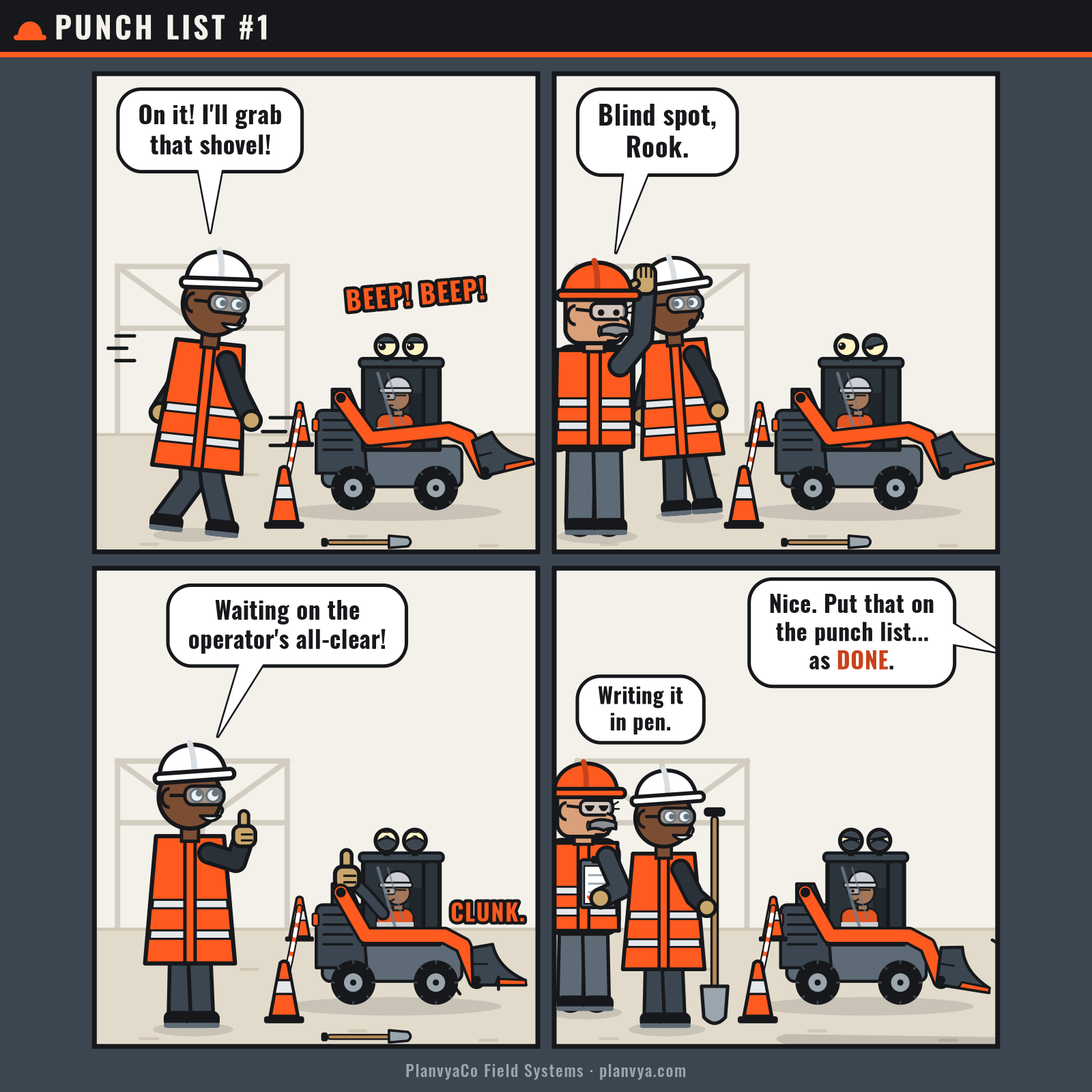
Punch List · Field Comics
From the Punch List archive.
The Week's Headlines
The live headline roundup runs on the current Field Edition. This page keeps the feature, the Safety Corner and the comic from Issue No. 2.
Back Issues
Email edition coming soon
This paper by email once a week. Signup isn't open yet, so there's nothing to fill in.
Coming soon